

#003 – Lead Magnets, Emails, Sales Funnels & Advertising

A lead magnet is a great way of getting potential customers contact details.
The lead magnet principle is a value exchange. You give a visitor something for free and in exchange they give you their contact details, so you can follow up with them afterwards.
The usual and most basic way to incorporate a lead magnet on your website is to offer a free resource in exchange for an email address.
The free resource can be whatever you want it to be, but more often than not, particular due to the ease of creation and delivery, this will be some kind of ebook.
Writing an ebook doesn’t mean you need to write hundreds of pages, in fact, shorter ebooks tend to do a lot better. Most of the time, your customer wants a quick win or a getting started guide.
A lead magnet ebook can usually be between 5-20 pages and doesn’t even need to be word count heavy, and could even be just images.
For a basic lead magnet, you would need, your free resource, a form to collect the user information, and a way of delivering the resource.
If you deliver your resource by email, then this also checks if the user gave you a correct, usable email address.
Most websites have just the one lead magnet, usually a free guide to the subject in question.
But studies have shown that websites with 10-15 different lead magnets perform much better.
My suggestion would be to have one larger lead magnet that is always on offer and then several smaller resources that can only be accessed on a particular pages and are much more specific to the topic rather than the overall subject.
 For instance, you have a fishing website – you sell fishing rods and reels.
The main lead magnet would be a free resource, say “Fishing Tips for Beginners”.
Then lets say you have a page about fly-fishing. So on that page, your lead magnet would be more specific “How to tie a fly”.
Being more specific not only creates more chances for the user to opt-in, it also gives you valuable information that allows you to segment the users into the more specific topics, helping you send targeted offers in the future.
Lead magnets can be triggered in many ways.
The standard is for a graphic and a button waiting to be pressed, which opens up a pop-up form.
Better ways include exit-intent forms (when the website visitor physically moves the mouse to close the website).
Or even when a visitor lands on certain pages or has been on the website a certain amount of time.
The complexity of these depends on your choice of Email Service Provider (ESP). However you implement lead magnets on your website, this is something that will greatly increase your customer experience, and your online business viability.
Twitter has 100 million daily active users. That’s a lot of people.
But, Facebook has way more with 1.4 billion users. That’s a fifth of everybody on the planet. Now that’s a lot of people.
However the number of people with an active email account is even larger with almost 4 billion people. That’s over half the population of the world and it’s probably nearer to 100% of the customers who you intend to sell your products or services to.
Email, no matter how old the system is, is still to this day, the most effective way for brands to communicate with their existing customers or promote to potential new customers.
Due to its unique one-on-one private messaging, emails outdo social media campaigns by a huge margin.
Over 90% of people check their emails on a daily basis and the majority of people check their email several times a day.
Emails can be broad, but more importantly emails can be super specific and targeted at the smallest niche.
For example, you own an online cupcake store and a customer bought a “Cappuccino Cupcake“. The following week you bring out a “Mocha Cupcake“.
 You can therefore send an email to the customer to tell them all about your new “Mocha Cupcake” as they have previously bought another coffee flavoured cake. Emails can be highly targeted and highly personal.
You can include the recipients name, their favourite cupcake (data from sales history), even send them a special 50% off coupon on their birthday.
As with your website, building a following on someone else’s land is not as important as owning the data yourself.
If you had thousands of Facebook friends or Twitter followers thats great.
But, what if they change their algorithms, charge you to contact people or simply delete your account.
That’s all those valuable contacts, time and money invested, gone to waste.
With your own email list, you have control over your own data. Of course, using an external email service provider like Mailchimp or Constant Contact, puts the data in their hands, but these services allow you to export your data at any time.
If you take this one step further, there are now WordPress Plugins (like FluentCRM) that allow you to run your email list directly from your WordPress admin area.
If you are creating an online business, having an email list is one of the most important things you can do.
For every visitor to your website, being able to continue the conversation with them long after they have left is an ideal way to promote your products or services in a highly targeted and personalised way.
Email is the number one strategy for lead generation and optimising sales and profits.
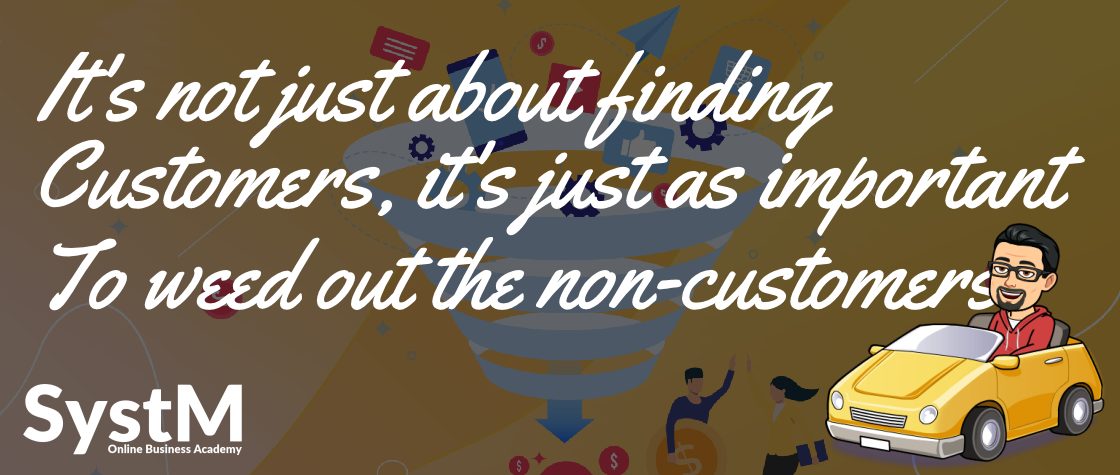
You may have heard the term “Sales Funnel” and had a vague idea of what it is, but maybe you haven’t looked at it in more detail. Knowing your sales funnel is very important in business.
The standard sales funnel has the four basic steps – Awareness, Interest, Decision and Action. But depending on your type of business, these steps can be broken down even further and even further still.
Your sales funnel could be much more detailed. And it’s in these details that make the difference between a poor sales funnel and a successful one.
To understand what a sales funnel is, let’s look at a basic one for a brick and mortar store.
People are walking past your store. They look in. They see what they like and they decide to walk in. That’s the first step – the Awareness step. You’ve made people aware of your store. Say 100 people walk past and 20 walk in. That’s 20%. Knowing the percentage at each stage helps you determine if your sales funnel is working. It only takes a small percentage increase or decrease to totally change the effectiveness of your funnel.
The second step is Interest. The 20 people now in your store look at your display of Star Wars T-Shirts. They are showing an interest. Four people pick out a lovely Jar Jar Binks t-shirt and they enter the next step – Decision. They have decided to buy a t-shirt.
 All they have to do now is walk to the checkout and part with their money. This is the action step, the final step in your sales funnel. But two people change their mind on the way and put the t-shirts back, maybe remembered that Jar Jar Binks isn’t all that.
Two people pay. So from the initial 100 people walking past your store, you have converted 2 of them into paying customers.
So now we know the four steps of our sales funnel, we can look at each in turn.
If we can get 200 people to walk past, we should sell four t-shirts. We’ve doubled our turnover.
We decide to stock some BB8 t-shirts as well as Jar Jar Binks. More people will decide to buy.
We make it easy to pay with no distractions, maybe even a poster stating Jar Jar Binks is cool ?
Again we have increased our turnover.
This same principle can easily be duplicated for an online business, but also include micro steps that could also be used to increase turnover. A step could be something like the flow of your checkout process or something as small as the wording in an email you send.
Later in the Roadmap we will look at how to optimise each step to increase turnover. The first step though is to identify your sales funnel and to start measuring its effectiveness.
Advertising can be split into two main groups. Free advertising and Paid advertising.
Another way to think of it, is advertising as a shortcut to more sales and you can either pay with your time or your wallet.
Free advertising usually means you will need to invest your time. This can be many different ways in which to get your message in front of potential customers. Posting online is of the best ways to have free advertising.
It could be a Facebook group, a forum or even a blog. It’s probably best not to be so bold as to directly advertise, particularly on someone else’s space, but instead be helpful. Post interesting articles or advice on a related subject. People will then gravitate towards you and in time will find your products and services. If they have had a good relationship with you up to that point, the old adage, know, like and trust will make it easier for them to become a paying customer.
Think of all the free content you consume on a daily basis. Think of the online people who you know, like and trust. If they brought out a paid product, or already have one, would you be more willing to part with your cash than to someone you don’t know who is blatantly advertising.
This sort of free advertising is how influencers work. They provide free information and advise and promote brands to their followers who trust them to only promote relevant brands and products.
Paid advertising is a totally different beast.

Without advertising the internet would be nothing like it is today. Google get the majority of their revenue still from brands and companies advertising on search results. Facebook makes its billions each year from the highly targeted ads that they run for companies that advertise with them.
In fact the majority of internet companies make money from advertising. Even old fashioned sectors like newspapers make the majority of their revenue from advertising rather than the sales of physical newspapers.
There are many ways you can advertise your online business and it depends on your branding, your product and your audience, where and how you advertise.
You could advertise on Google Ads if most of your audience are searching for your product or service.
Or Facebook, if your product can be shared or has potential to be viral.
Youtube is another great place to advertise, as most people don’t know, but Youtube is the second largest search engine.
If your product is very niche, you could even reach out to owners of a similar, but not competitive, website to place ads in front of their visitors.
However you decide to advertise, either with time or your wallet, its imperative to keep an eye on the numbers, to see what is and what isn’t working.
Start with one advertising channel, get it working with a good ROI (return on investment). Then rinse and repeat.

Responses